





.svg)

How to build an effective VoC program

What a VoC program actually is
Intro
You're getting feedback. Probably a lot of it.
Support tickets stacking up in Zendesk. NPS responses sitting in a spreadsheet someone updates every quarter. Sales call notes living in the heads of your AEs. App store reviews that nobody's read since last month. User interviews that a PM ran six weeks ago and summarized in a Notion doc that three people have opened.
The information is there. Your customers are talking to you. But none of it is connected, none of it is actionable, and no one in your company has a clear, unified picture of what your customers actually think, want, or need.
That's not a data problem. That's a structure problem. And it's exactly why building a proper Voice of Customer program is one of the highest-leverage investments a product or CX team can make.
We built Zefi because we lived this problem firsthand, as operators, as product people, as founders. We saw companies drowning in feedback while making decisions in the dark. This guide is our attempt to share everything we've learned about building a VoC program that doesn't just collect customer voices, but turns them into something your entire company can act on.
What a VoC program actually is (and what it's not)
Let's get the definition right, because there's a lot of confusion here.
A Voice of Customer program is a structured system for capturing, analyzing, and acting on what customers are telling you, across every channel, every touchpoint, and every interaction where they're expressing something true about their experience.
Notice what's not in that definition: surveys. Surveys are one input into a VoC program. They are not the program itself.
A lot of teams think they have a VoC program when they actually have a collection of disconnected tools. An NPS survey here. A Typeform there. A tagging system in their support tool that someone maintains inconsistently. These are fragments. A VoC program is what happens when you connect those fragments into something coherent and actionable.
Here's a simple test: if someone in your company asks "what are the top three things our customers are frustrated with right now?", how long does it take to answer that question? If the answer is "a few hours" or "let me ask around," you don't have a VoC program. You have inputs.
The goal of a real VoC program is to make that answer available in minutes, and to make it trustworthy enough that product, leadership, and CX are all making decisions based on the same picture.
Why most VoC efforts fail
We've talked to hundreds of product and CX teams over the years. The pattern is almost always the same.
A well-intentioned person (usually a product manager, a CX lead, or a customer insights analyst), decides to "get more systematic about feedback":
- They set up some processes.
- They create a tagging taxonomy in their support tool.
- They start a regular cadence of user interviews.
- They build a dashboard.
Six months later, the taxonomy has drifted. The tags are inconsistent because four people are tagging differently and nobody owns it. The interviews are still happening but the insights aren't being read by anyone who builds the product. The dashboard shows volume, but not meaning. And the well-intentioned person is spending 80% of their time manually stitching data together, and 20% trying to convince stakeholders to care about what it says.
The failure mode isn't a lack of data. It's a lack of structure, ownership, and scalability.
Here are the four most common reasons VoC programs break down:
- Feedback lives in silos.
Support data in one tool, survey data in another, qualitative research in Notion docs, sales feedback in CRM notes. Nobody has the full picture so everybody has a partial one.
- Analysis doesn't scale.
Manual tagging and reading works when you have 50 tickets a week. It breaks at 500. Most teams never build the infrastructure to go from "reading feedback" to "understanding feedback at scale."
- Insights don't reach the right people.
Product builds what support screams loudest about. Leadership hears what fits the narrative of the last all-hands. The full signal gets filtered, diluted, or buried before it reaches the people who can act on it.
- There's no feedback loop.
Customers share something, nothing changes, they never hear back, they stop sharing. The VoC program slowly loses its best inputs because nobody closes the loop.
A real VoC program is designed to solve all four of these. Not just collect more. Collect smarter, analyze automatically, distribute intelligently, and close the loop.
The 5 pillars of a VoC program that works
We think about a great VoC program as having five interconnected pillars. Skip any one of them and the whole thing becomes fragile.
Pillar 1: Unified Feedback Collection
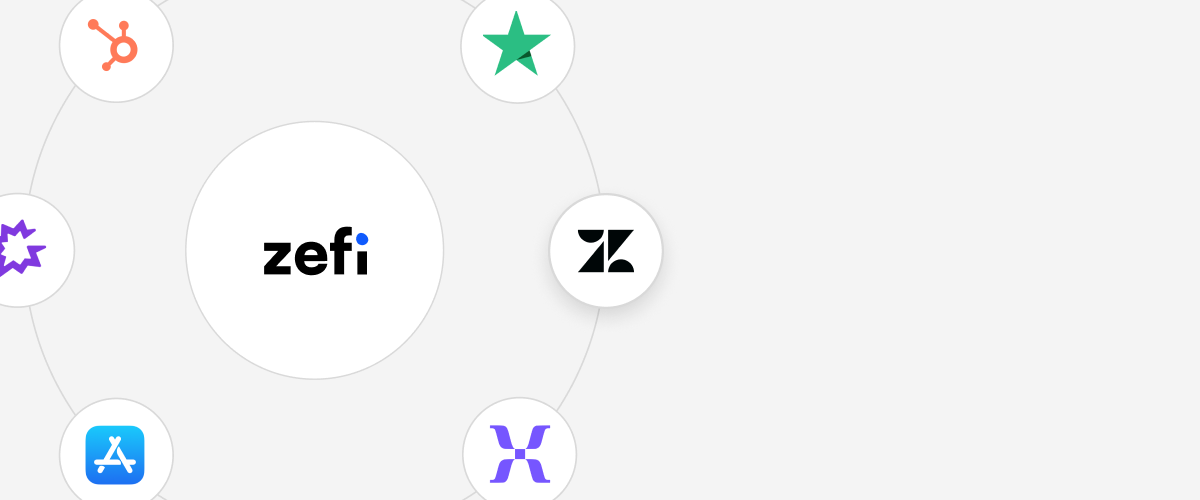
Your customers talk to you in more places than you think. Support tickets. In-product surveys. App store reviews. Sales calls. Community forums. Social media. NPS and CSAT responses. User interviews. Churn surveys. Onboarding feedback.
The first job of a VoC program is to make sure none of that gets lost. Not because you need to read all of it manually (you don't and you can't) but because patterns only emerge when you're working with the full picture.
The practical implication: you need a single place where all feedback flows. Not a document, not a folder, not a person's inbox. A centralized system where every input lands, is timestamped, and is associated with the customer who gave it.
At Zefi, this is where we start with every team we work with: connecting all your feedback sources in one place before doing anything else. It sounds simple, but most teams have never actually done it. When they do, the first reaction is always some version of "oh, we had no idea this was happening."
Pillar 2: A Taxonomy You Actually Control
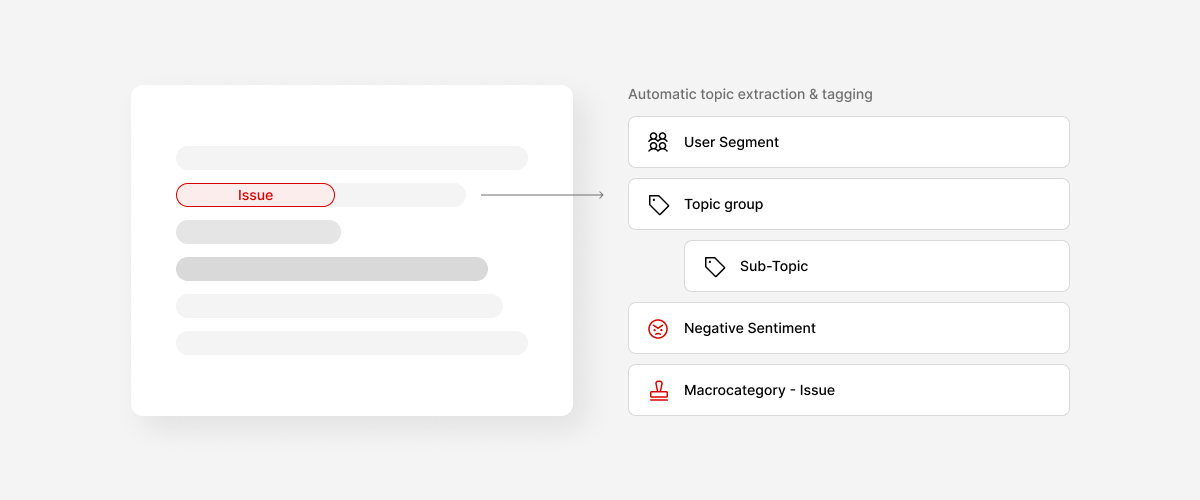
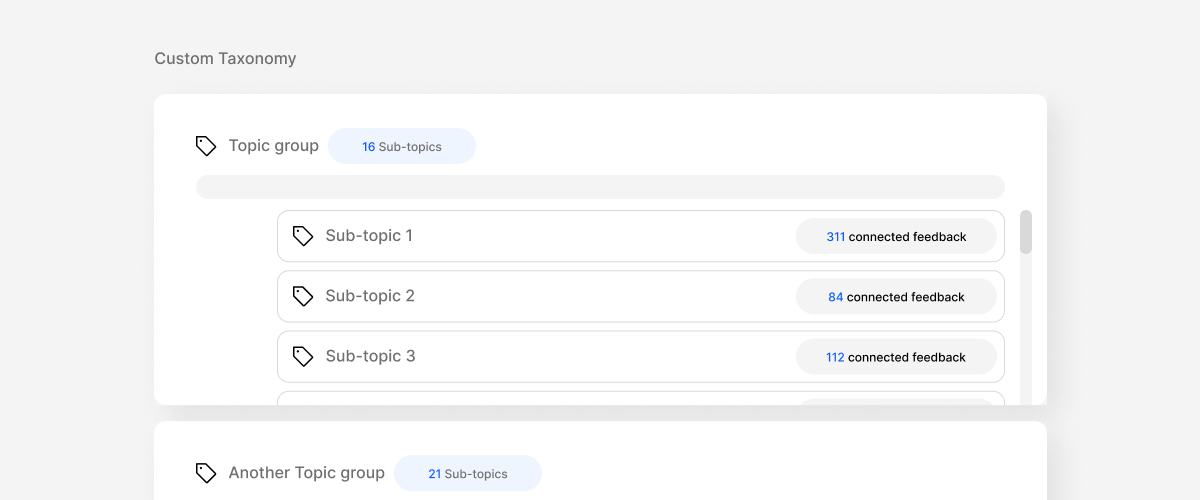
Raw feedback isn't insight. A thousand support tickets aren't a strategy. To turn volume into understanding, you need a way to categorize and label what's coming in. A taxonomy.
This is where most teams go wrong. They either don't have a taxonomy at all (pure volume, no structure), or they have one that's so rigid it can't keep up with a changing product, or they have one that nobody actually maintains consistently.
A good taxonomy does a few things: it's specific enough to be meaningful, flexible enough to evolve, and governed well enough that different people applying it get consistent results. And in 2026, the best taxonomies aren't maintained manually, they're powered by AI that learns from your corrections and keeps itself up to date as your product changes.
The taxonomy is the backbone of your VoC program. Everything downstream (prioritization, reporting, alerting) depends on getting this right.
Pillar 3: Business Context
This is the one most teams miss, and it's where the real competitive advantage lives.
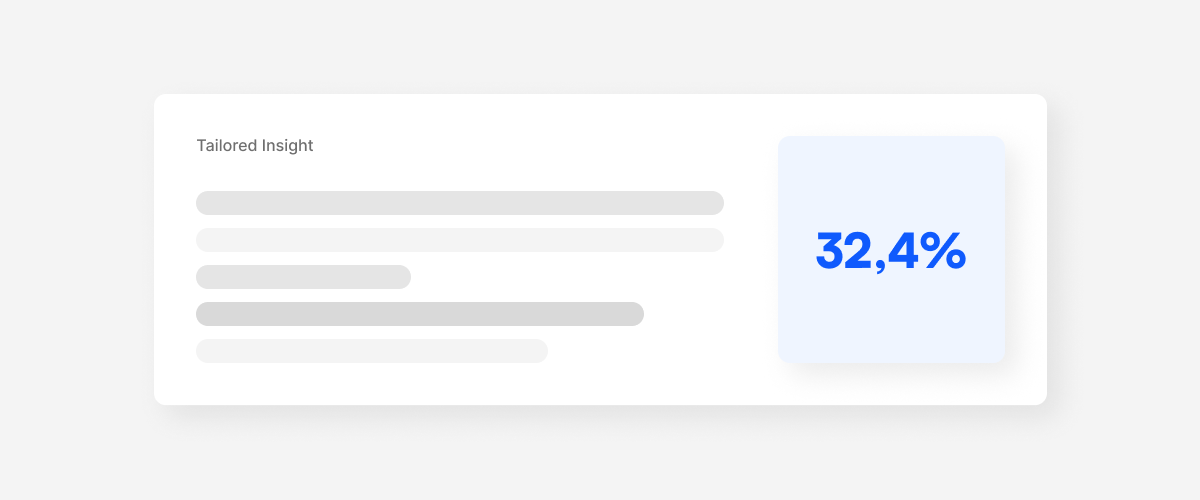
Not all feedback is equal. A bug report from a customer who pays €50/month is different from the same bug report from an Enterprise customer who pays €50,000/month and is at renewal risk. A feature request from five customers in a segment you're actively growing is more valuable than the same request from customers you're churning. A complaint that correlates with 40% of your churn in the last quarter deserves more attention than the same complaint from customers who've been happy for years.
A VoC program without business context gives you feedback. A VoC program with business context gives you strategy.
This means connecting your feedback to your CRM, your subscription data, your health scores (or calculate better ones), your product usage data. It means being able to filter not just by "topic" but by "topic, from customers in segment X, who are at risk of churning." That's the question that changes what you build next.
Pillar 4: A Rhythm for Action
Here's the uncomfortable truth: the best-analyzed feedback in the world is worthless if it doesn't change what your team does.
This requires two things. First, the right people need to see the right insights at the right time, not in a quarterly review, not buried in a 40-page report, but as part of the natural rhythm of how your team works. Weekly digests in Slack. Alerts when a new issue spikes. Automated tickets in Jira when a threshold is crossed.
Second, there needs to be a clear process for what happens when an insight lands. Who owns the decision? How does it get into the roadmap? How do you know when it's been addressed?
VoC without a feedback-to-action loop is just a listening exercise. The companies that get value from it treat insights like any other input into their planning process, with owners, priorities, and outcomes.
Pillar 5: Closing the Loop
This one's easy to skip and expensive to ignore.
When a customer reports a problem, asks for a feature, or shares frustration, and then nothing changes and nobody ever tells them, you're slowly training your most engaged customers to stop engaging. The customers who bother to tell you things are your most valuable signal. If they don't see the feedback loop closed, they stop giving feedback.
Closing the loop means letting customers know when their feedback has been heard, when it's influenced a decision, when the thing they asked for has shipped. It doesn't have to be elaborate. Sometimes it's an automated reply when a known issue is resolved. Sometimes it's a personal note from a PM. But it has to exist.
How to actually build your VoC program (step by step)
Alright, enough theory. Here's how to actually build this.
Step 1: Map Your Feedback Sources
Start by answering one question: where is customer feedback actually living right now?
List every channel. Support tickets, NPS/CSAT surveys, in-product feedback, sales call notes, user interviews, app store reviews, social mentions, community forums, churn interviews, onboarding calls. Be exhaustive. You'll almost certainly find sources you'd forgotten about.
For each source, note: how many inputs per week, who currently owns it, and what happens to it (is it being read? tagged? stored somewhere?).
This mapping exercise usually produces two reactions. First, surprise at how many sources exist. Second, horror at how little of it is being used. Both reactions are useful. The map tells you where to start.
Step 2: Define What Decisions This Program Needs to Serve
Before you build anything, get clear on the outputs.
What questions does your organization need to answer with customer feedback? Some common ones:
- What are the biggest product gaps affecting retention?
- What's blocking expansion in our enterprise segment?
- What do customers love most that we shouldn't break?
- What's the #1 reason customers churn?
If you build a VoC program without knowing what decisions it needs to serve, you'll end up with a very complete picture of nothing in particular. The program needs to be designed around the questions that your team actually needs answered.
Get alignment from CX, product, and leadership on what those questions are. That's your north star.
Step 3: Choose Your Taxonomy
Now design your categorization system. What are the major themes, topics, and issue types you want to track?
Don't try to build the perfect taxonomy on day one. Start with the most important dimensions:
- product areas (the parts of your product customers talk about)
- issue types (bugs, friction, missing features, praise, confusion)
- and customer sentiment (positive, neutral, negative).
You can get more sophisticated over time.
The key rule: own your taxonomy.
Don't let it become whatever your tool suggests as default categories. Your product has specific areas that matter to your strategy. Your taxonomy should reflect that.
At Zefi, we let teams build their own taxonomy and then use AI to apply it consistently at scale, which means the taxonomy can be as specific and nuanced as you want, without the manual overhead of maintaining it.
Step 4: Connect and Centralize Your Sources
With your taxonomy in hand, start connecting your feedback sources to your central system. Start with your two or three highest-volume sources (typically support and surveys) and get those flowing in first.
Don't wait until you have every source connected before you start getting value. Each source you add increases the completeness of your picture. Start with the ones that generate the most signal.
Once your sources are connected, apply your taxonomy. Tag historical data if you can, even a month of back-data is enough to establish baselines.
Step 5: Connect to Business Context
Now connect your feedback to your customer data. This is typically a CRM integration (Salesforce, HubSpot, or similar) that lets you segment feedback by customer tier, ARR, health score, or lifecycle stage.
The goal is to be able to answer questions like: "What are enterprise customers saying about feature X?" or "What are customers who churned in the last 90 days saying they wanted?" Without business context, you can't distinguish signal from noise. With it, your VoC data becomes a strategic asset.
Step 6: Build Your Distribution Rhythm
Decide how insights flow to different stakeholders. Some options:
- Weekly digest:
for product and CX leads: top trending topics, new spikes, notable individual feedback
- Real-time alerts:
for critical issues: when a topic crosses a volume threshold, when sentiment on a feature drops sharply, when a high-value customer flags a problem
- Monthly report:
for leadership: top themes, trend analysis, correlation with business metrics
- Ad hoc queries:
for anyone who needs to answer a specific question
The right distribution depends on your team's rhythm. The important thing is that insights don't sit in a tool waiting to be discovered. They come to the people who need them.
Step 7: Establish Ownership and Closing the Loop
Assign a clear owner for the VoC program. This person doesn't have to do everything, they're accountable for the health of the system, not for personally reading every ticket.
Then define your close-the-loop process. How do customers get notified when known issues are resolved? How do customers who made feature requests get notified when those features ship? It doesn't need to be complex, but it needs to exist.
What "Good" looks like at different stages
Not every company needs to build the full system on day one. Here's what "good" looks like at different stages of company maturity.
Early Stage (0–few hundred customers)
At this stage, you should be talking to customers directly and often. Your VoC program is mostly: a shared place to store feedback, a simple taxonomy to tag it, and a regular meeting where you review what you're hearing.
The goal here isn't scale, it's not to miss anything important. Every piece of feedback is potentially a signal. The risk at this stage is that insights live only in the heads of the people who talked to customers and never make it into a decision.
Growth Stage (few thousands customers)
Now volume is starting to be a challenge. You can't personally read every ticket. Manual tagging is breaking down. You need structure.
At this stage, you should be building the full five-pillar framework: centralized sources, a real taxonomy applied consistently with AI assistance, basic business context segmentation, and a regular distribution cadence. The close-the-loop process should be defined even if not fully automated.
Scale / Mature Stage (hundred thousands / millions customers)
At scale, the risk isn't missing feedback, it's being overwhelmed by it. The priority becomes automation, intelligence, and making sure the right signals reach the right people without requiring manual work.
This is where AI really earns its place. Automatic categorization. Trend detection. Anomaly alerts. Correlation with business metrics. Workflow automation that creates tickets, sends alerts, and closes loops without human intervention at every step.
At this stage, your VoC program should be less a "program someone runs" and more a system that runs itself, surfacing the things that matter and routing them to the people who need them.
The role of AI in modern VoC programs
We'd be doing you a disservice if we didn't talk directly about AI here, because the technology has genuinely changed what's possible.
Three years ago, building a VoC program at scale meant either hiring a team of analysts or accepting that your analysis would be shallow. Manual tagging breaks at volume. Qualitative analysis doesn't scale. You had to choose between breadth and depth.
AI changes that tradeoff fundamentally.
Automatic categorization means you can apply a nuanced, multi-dimensional taxonomy to thousands of pieces of feedback per week without any manual work. The AI learns from your corrections and gets better over time.
Semantic search and clustering means you can ask "what are customers saying about our onboarding?" and get a synthesized answer across all your sources, not just a keyword search.
Trend detection means you don't have to monitor dashboards manually. The system tells you when something is spiking, when sentiment is shifting, when a new topic is emerging.
Correlation analysis means you can connect feedback patterns to business outcomes. Which issues correlate with churn, which features correlate with expansion, which topics matter most for your highest-value segments.
But here's the important caveat: AI amplifies good structure. If your taxonomy is bad, AI will apply bad tags at scale. If your data is siloed, AI can only analyze the silo it can see. The five pillars still matter. AI makes them faster and more powerful, but it doesn't replace them.
The best VoC programs we see combine human judgment (defining what matters, designing the taxonomy, deciding how to act) with AI execution (applying the taxonomy consistently, surfacing patterns, automating workflows). That combination is what makes it possible to actually listen to every customer, at scale, without burning out your team.
Getting your organization to care
We want to end with something that often gets left out of guides like this: building the internal buy-in for a VoC program is often harder than building the program itself.
You can have the most sophisticated feedback analysis infrastructure in the world. If product doesn't trust it, if leadership doesn't use it, if engineers don't see the relevance, it doesn't matter.
Here's what we've seen work.
Start with a win. Before you try to convince anyone to change how they work, find a specific decision that VoC data could have made better. Show what you would have known, and when, if the program had existed. That's more persuasive than any deck.
Make it easy to consume. Insights need to come to people, not require people to come to them. Push the relevant signal into Slack, into Jira, into the tools people already live in. A beautiful dashboard that requires a weekly login will be visited three times and forgotten.
Connect feedback to outcomes people care about. "Customers are frustrated with onboarding" is abstract. "This onboarding issue correlates with 30% of our churn in the last quarter, which represents €X in ARR" is a budget conversation. Tie VoC insights to the metrics your stakeholders already track.
Own the synthesis, not just the data. Data is not insight. Your job as the VoC program owner is to take the raw signal and synthesize it into something decision-ready. That means a clear point of view: here's what we're hearing, here's what it means, here's what we recommend doing about it.
Close the loop visibly. When a VoC insight leads to a decision, make sure everyone knows. "We shipped X because 340 customers asked for it in the last 90 days." That visibility builds trust in the program and creates flywheel behavior. More people contribute to it, more people use it.
The Bottom Line
Your customers are already telling you everything you need to know to build a better product, reduce churn, and grow faster. The question is whether you have a system to hear them.
A Voice of Customer program isn't a nice-to-have for teams that care about users. It's the infrastructure for making good decisions at scale (across product, CX, and leadership) in a world where customer feedback comes in faster than any human can process it.
The companies we admire most don't just build features. They build feedback loops. They treat the voice of their customers as a competitive asset and invest accordingly.
If you're ready to stop guessing and start listening (really listening) we'd love to show you what that looks like with Zefi.
A member of our team will get in touch soon

Extract value from user feedback
Unify and categorize all feedback automatically.
Prioritize better and build what matters.



.svg)

